
Ask “how does dota 2 scoring work,” and the answer depends on the score you mean. Dota 2 can be measured by the match scoreboard, Fantasy League points, or ranked matchmaking. The scoreboard tracks performance, Fantasy turns actions into points, and ranked uses MMR and medals instead of one live score.
What “scoring” means in Dota 2
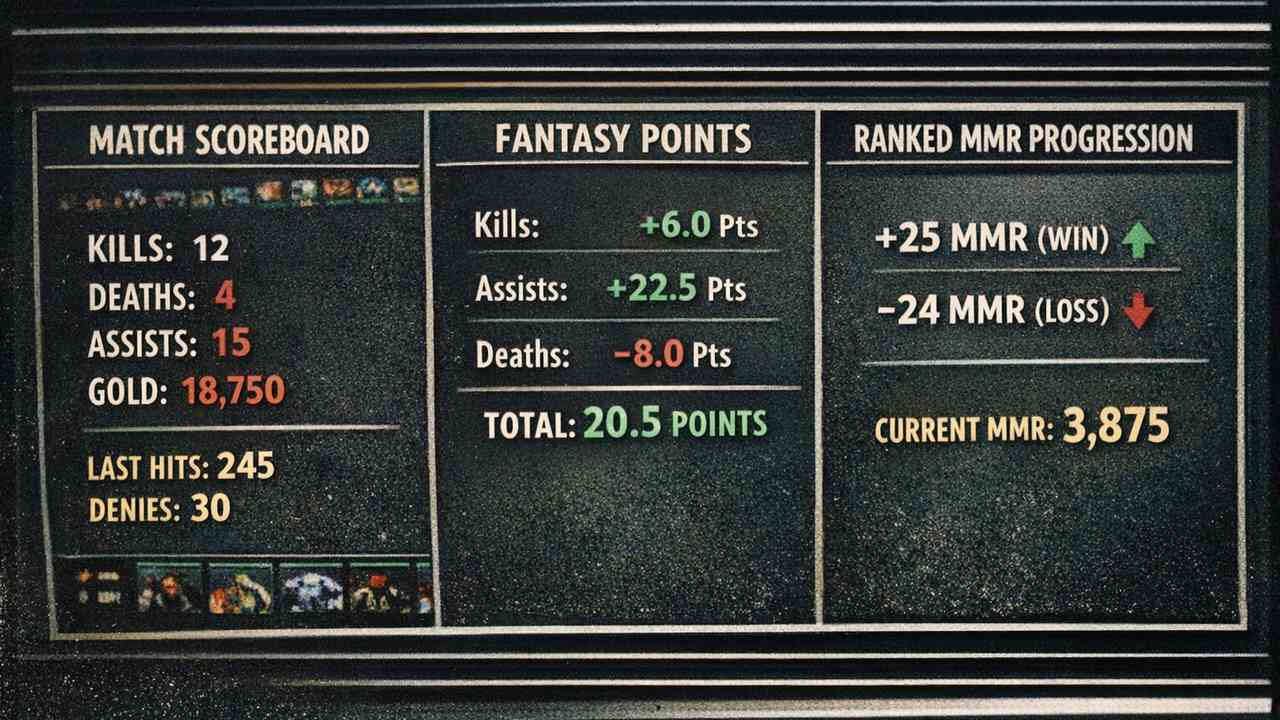
Dota 2 scoring usually points to one of three systems. Match stats describe a single game: kills, deaths, farm, damage, vision, and objectives. Fantasy League scoring turns selected pro-player stats into points for a separate contest. Ranked scoring is your matchmaking rating and medal progress.
They connect, but they are not the same thing. A clean scoreline can reflect strong play, but a high KDA does not automatically raise MMR, and Fantasy points do not affect ranked placement.
How Dota 2 match scoring works during a game
The in-game scoreboard is a tool, not the win condition. Dota 2 is won by destroying the enemy Ancient, so the best stats are the ones that help secure fights, towers, Roshan, map control, and the final push.
Common match stats include:
- Kills, deaths, and assists
- Last hits and denies
- Net worth, GPM, and XPM
- Hero damage, building damage, and healing
- Objective involvement
- Wards, detection, stacks, saves, and support impact
Kills, deaths, and assists
KDA shows fight involvement and risk. Context matters: a carry dying before Roshan hurts more than a support dying to save a core or break a smoke.
Last hits, denies, GPM, and XPM
Last hits and denies show lane control. GPM and XPM show resource growth. Cores lean on these numbers more than supports, who often trade income for vision and movement.
Objectives and team impact
Objective impact tells the real story. Building damage, Roshan setup, ward control, buybacks, and tower pressure often matter more than the raw kill count.
How Dota 2 Fantasy League scoring works
Fantasy League scoring converts player performance into points using set stat categories. The active in-game rules or official Steam Support page should be treated as the source, since formats can change. The examples below are verified from official Steam Support wording.
| Fantasy stat category | Point value |
|---|---|
| Kill | 0.3 points |
| Death | -0.3 points |
| Assist | 0.15 points |
| Last hit | 0.003 points |
| Gold per minute | 0.002 points |
Fantasy points are separate from match results and ranked rating. They reward selected measurable actions for Fantasy contests; they do not decide who wins a Dota 2 match or how ranked MMR changes.
How Dota 2 ranked scoring works
Ranked scoring is represented mainly by MMR and medal rank. The medal is the visible badge, while matchmaking uses an underlying rating to place players into games. In regular ranked play, match outcome is the main driver: wins move you upward over time, losses move you downward.
The scoreboard can help explain why a game was won or lost, but it is not a direct MMR point sheet.
Calibration Matches
Calibration helps the system estimate your ranked level when your placement is uncertain. These games influence where your displayed rank settles, but they are not judged by one stat alone.
Rank Confidence
Rank confidence reflects how sure the system is about your placement. More ranked games give the matchmaker more evidence and can make your visible rank feel steadier.
Matchmaking Formula
Valve does not publish every matchmaking detail. For players, the practical rule is simple: consistent wins against suitable opponents push rank upward.
All Dota 2 ranks at a glance
Dota 2 rank medals run from beginner brackets to the highest ladder. Most medals have star progress within the tier, while Immortal connects more closely to top-end rating and leaderboard placement.
| Order | Rank medal |
|---|---|
| 1 | Herald |
| 2 | Guardian |
| 3 | Crusader |
| 4 | Archon |
| 5 | Legend |
| 6 | Ancient |
| 7 | Divine |
| 8 | Immortal |
The medal is the public label, not the whole matchmaking picture. Two players near a medal border can look similar while their underlying ratings still differ.
How MMR is calculated in Dota 2
MMR is a skill estimate adjusted through ranked results. Winning generally increases it, losing generally decreases it, and calibration or recalibration can make placement feel less settled while the system reassesses you.
Party and solo games create different match contexts, but Valve does not publish a full formula. Avoid treating any public stat as a guaranteed explanation for every rating change.
Visible MMR vs hidden matchmaking factors
Visible MMR or medal progress is what players can track. Hidden factors may help create fair matches or measure uncertainty, but they are not a public bonus table for kills, farm, or damage.
Why KDA does not directly equal rank gain
KDA is part of the match story, not the ranked currency. A high KDA helps only if it contributes to winning the game.
When Dota 2 ranks reset or recalibrate
Recalibration is separate from normal ranked movement. Regular matches adjust rating after wins and losses; recalibration is a broader reassessment of where your account belongs. It can move your displayed rank more noticeably because the system is working with renewed uncertainty.
Treat recalibration as a checkpoint, not a shortcut. Stable heroes, clear role execution, and reviewable decision-making matter more than chasing unusual stats for a few games.
How recalibration affects your displayed rank
During recalibration, your medal can shift while the system gathers fresh evidence. Once enough games support the estimate, your visible rank should settle into a more stable range.
Immortal leaderboard and high-rank scoring
At Immortal, ranked scoring becomes more granular because leaderboard position can matter. Players are no longer only chasing the next medal; they may also be competing for numbered placement among other high-rated accounts.
The foundation is still matchmaking rating and match results. At this level, small draft, lane, buyback, and positioning errors get punished fast. Strong scoreboard numbers matter less than repeatable decisions that win against strong opponents.
Common myths about Dota 2 scoring
- High KDA always means you gain more MMR: ranked movement is tied mainly to winning and losing.
- Support stats do not matter: vision, disables, saves, stacks, and smoke plays can decide games.
- Party queue always hurts MMR: party games are not automatically bad; coordination and results matter.
- Fantasy scoring is the same as ranked scoring: Fantasy uses stat point values, while ranked uses MMR and medals.
- More kills means the better team is winning: towers, Roshan, buybacks, and Ancient pressure decide the result.
How to improve the numbers that matter
- Improve last hitting so your lane economy does not rely on risky kills.
- Reduce deaths before objectives, rune fights, Roshan, and buyback windows.
- Turn won fights into towers, wards, Roshan, or safe map control.
- Communicate with short calls about cooldowns, smokes, wards, and targets.
- Review replays for repeated mistakes: first death, missed teleports, bad ward paths, or unused spells.
- Measure your role correctly: cores need timing and damage; supports need vision, setup, saves, and control.
- Avoid stat padding when safer objective play can win the map.
Frequently asked questions
Does KDA affect MMR in Dota 2?
KDA does not directly convert into MMR. It matters when it helps your team win the match.
How are Dota 2 Fantasy League points calculated?
Fantasy points come from assigned values for categories such as kills, deaths, assists, last hits, and GPM. Check the active official rules because formats can vary.
Is MMR the same as rank medal?
No. MMR is the underlying rating, while the medal is the visible badge summarizing your standing.
Do support players score worse than core players?
Not necessarily. Supports often show impact through vision, disables, saves, fight setup, and map movement rather than farm-heavy stats.
Can you win a Dota 2 game with worse stats than the enemy team?
Yes. A team can trail in kills and still win through objectives, high-ground defense, buybacks, or one decisive fight.