
If you want to learn how to play Dota 2 for beginners, start with the win condition: Dota 2 is a 5v5 strategy game where each team tries to destroy the enemy Ancient. You control one hero, work with four teammates, and use waves, fights, vision, and item timings to push closer to the enemy base.
What is Dota 2 and how do you win?
Dota 2 is a 5v5 strategy game where each team wins by destroying the enemy Ancient. Each player controls one hero, and each team turns gold, experience, map control, and objectives into a route through the enemy base.
The two teams start on opposite sides of the map. Computer-controlled creeps march down three lanes and fight whatever enemies they meet. Chasing kills by itself will not win the game; your team uses pressure to take towers, secure safer farm, place better vision, and eventually reach the Ancient.
Towers defend each lane, so early base attacks usually fail. For beginners, the plan is simpler: survive or win the lane, collect gold and levels, take nearby objectives, and group when the team is ready to push.
The Ancient, towers, and barracks
The Ancient sits inside each base and ends the game when a team destroys it. Towers protect lanes and slow enemy pushes. Teams usually destroy outer towers, inner towers, high-ground defenses, and barracks before they attack the Ancient. Barracks weaken the enemy’s lane defense and make later pushes stronger.
Gold, experience, and hero levels
Gold buys items, and experience gives levels and stronger abilities. Last-hitting creeps, joining good fights, and staying alive help your hero grow. Repeated deaths hurt your item timing and hand the enemy more control over the map.
The Dota 2 map, lanes, and objectives
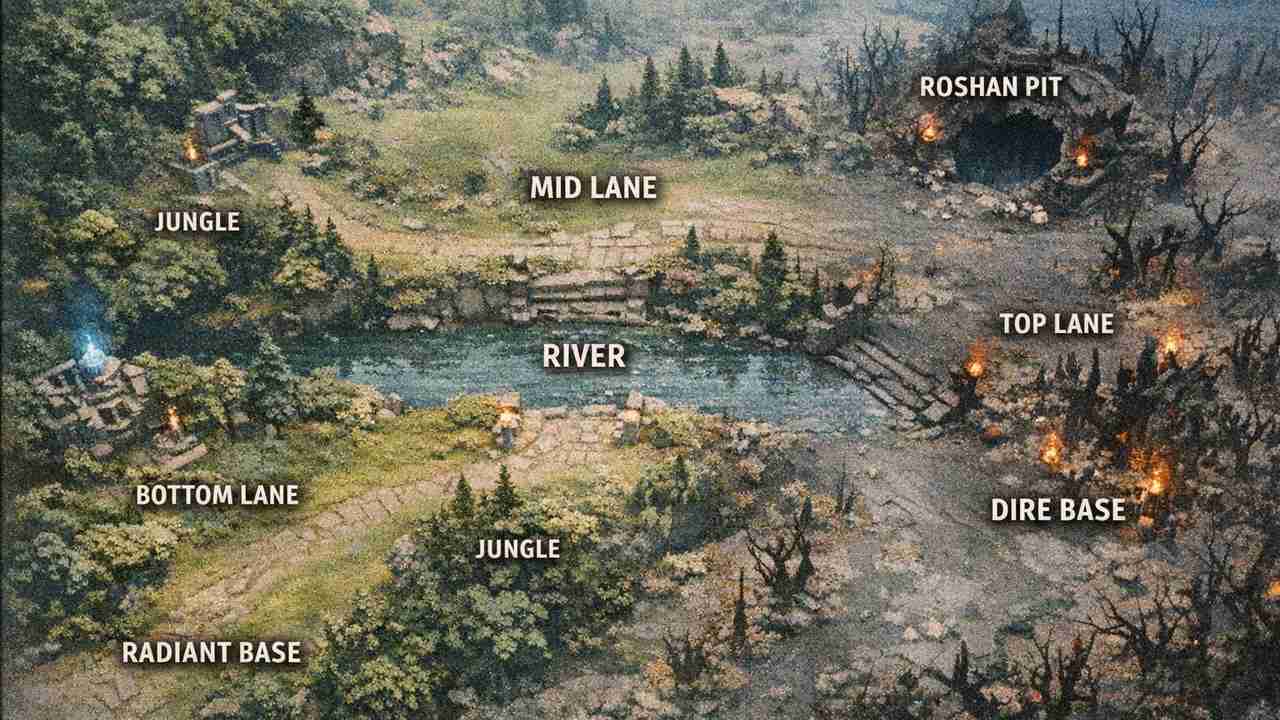
The Dota 2 map has three lanes, a river, jungle areas, and two bases. Lanes bring creep waves, creep waves give gold and experience, and objectives turn lane pressure into map control.
Top, mid, and bottom lanes are the main resource paths. The jungle adds extra farm, but enemies can punish players who walk into dark areas without vision. The river connects rotations and leads toward contested objectives.
Check the minimap before you cross the river or farm far from allies. If enemy heroes disappear from vision, move closer to teammates, towers, or warded areas.
Lane creeps and neutral creeps
Lane creeps spawn automatically and push toward enemy buildings. Neutral creeps stay in jungle camps until a hero attacks them. New players should learn lane creeps first, then add jungle camps when their hero can clear them without losing too much health or time.
Roshan
Roshan is a strong neutral boss in a pit near the river. Teams usually attack Roshan when they have vision, nearby allies, or dead enemies. As a beginner, do not force Roshan alone; watch for team movement around the pit.
Outposts, Twin Gates, Lotus Pools, and Tormentors
These map features create extra reasons to leave lane. Outposts support map control, Twin Gates move heroes across side areas, Lotus Pools give a small resource to contest, and Tormentors reward grouped teams later. Treat these objectives as team decisions, not distractions from your main job.
Choosing your role and hero
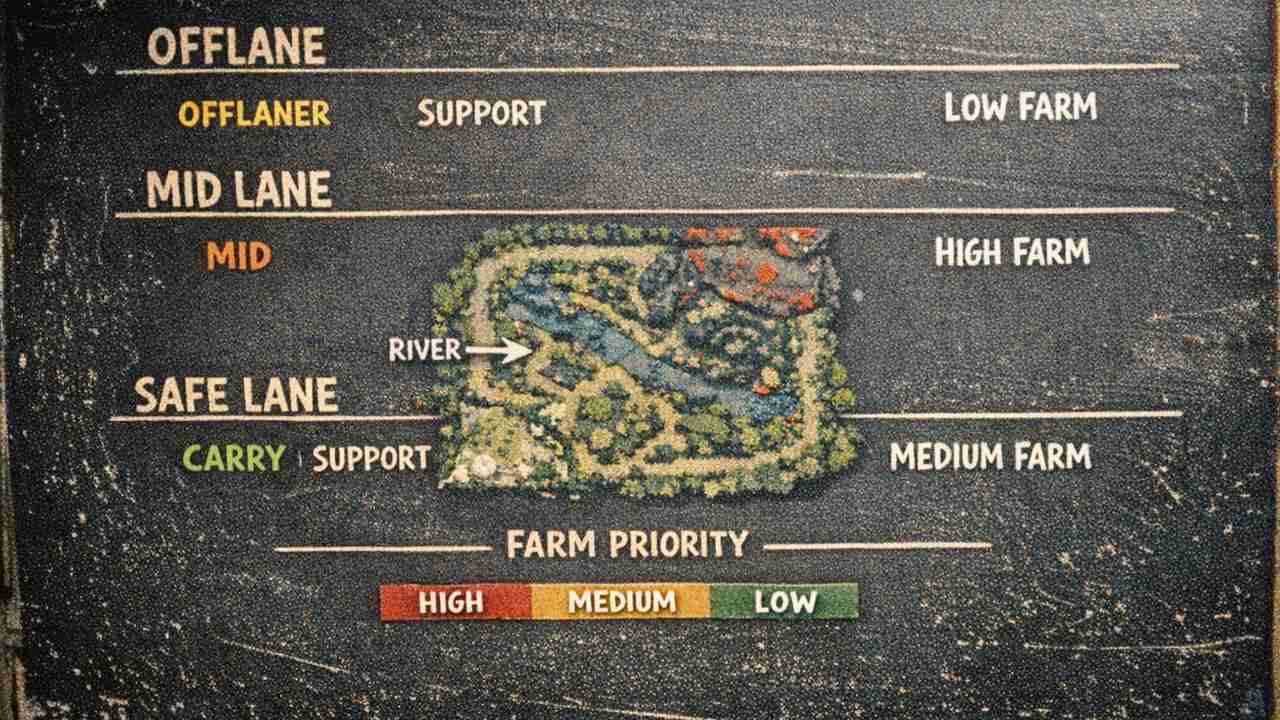
Choose one role and a small hero pool when you start. Roles set farm priority, fight responsibility, and lane jobs, so repeating one role makes each match easier to read.
A carry needs more gold, while a support can help the team with less farm. A mid hero often gains levels quickly, and an offlaner pressures the enemy carry. The team functions better when each player knows who farms, who starts fights, and who protects vision.
For anyone learning how to play Dota 2 for beginners, one role is enough at first. Repetition teaches lane matchups, farm priority, and teamfight timing faster than switching jobs every match.
Carry
The carry farms for key items and becomes a major damage source later. The carry role rewards patience, safe farming, and selective fighting.
Mid
The mid hero plays alone in the center lane and often gains levels quickly. The mid role demands matchup knowledge, rune control, and early rotations.
Offlane
The offlaner pressures the enemy carry and often becomes a durable fight starter. The offlane role suits players who like disrupting farm, surviving pressure, and creating space.
Support
Supports help lanes, place wards, buy useful team items, and protect cores. The support role teaches map awareness and teamwork without requiring the most farm.
Beginner-friendly heroes and heroes to avoid
Beginner-friendly heroes use clear spells, simple positioning, durability, or obvious teamfight impact. New players should choose heroes that let them learn lanes, vision, farming, and safe movement before taking on advanced mechanics.
Straightforward supports, tanky offlaners, and basic right-click carries help you focus on the map. Durable heroes forgive some positioning errors, and simple spells make fights easier to understand.
Save highly complex heroes for later. Micro-heavy heroes require control of multiple units, fragile combo heroes punish one missed spell, and timing-based heroes can lose fights through one small mistake.
Core gameplay concepts every beginner needs
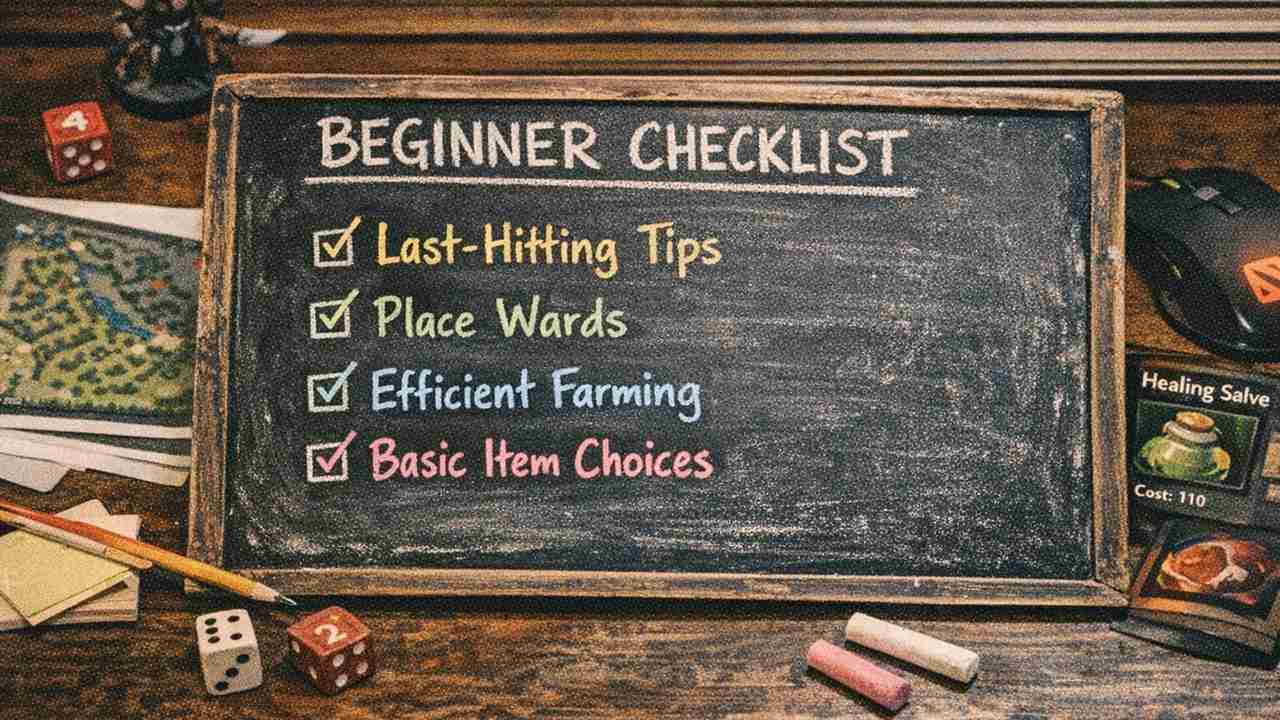
The fastest early improvement comes from repeatable basics. Last hits give gold, wards reveal danger, farming patterns build items, and safe movement prevents low-value deaths.
Once you can last-hit, read the minimap, follow a sensible build, and avoid needless deaths, the game starts to feel slower. Build these habits before you worry about advanced strategy.
Last-hitting and denying
You get gold when your hero lands the killing blow on an enemy creep. Denying means killing your own low-health creep to reduce what the enemy gains. Practice last hits first; denying becomes easier after attack timing feels natural.
Warding and map awareness
Wards reveal areas of the map and help your team avoid ambushes or prepare fights. Check the minimap after last hits, spell casts, camp clears, and before crossing the river.
Farming patterns and efficiency
A farming pattern routes your hero between lane waves, jungle camps, and safe space. Good patterns keep gold coming without sending your hero into missing enemies. If several opponents disappear from the minimap, farm nearer to allies or towers.
Itemization and guides
Items solve specific problems: survival, damage, mobility, regeneration, control, or team utility. Use in-game guides early, then read item descriptions after the match so item builds start to make sense.
Action priorities
When unsure, choose a useful low-risk action. Push a safe wave, defend a tower, place vision, farm toward an item, or group when your team has numbers. Do not chase a kill that gives up a larger objective.
Items, shops, and builds
Items shape your hero’s timing and solve match problems. A guide helps beginners buy the right components, use the correct shop, and reach key items before fights matter.
A slow hero may need mobility, a fragile hero may need survivability, and a support may need utility to save allies or control enemies. Random purchases delay the moment when your hero should be strong.
Use in-game guides while learning the shop. Guides reduce decision overload and show common item paths. Some items use components from different shops, including the Secret Shop, so check the build before you need an item in a hurry.
The different phases of a Dota 2 match
A Dota 2 match changes as heroes gain levels, items, and map access. Beginners should adjust priorities across the early game, midgame, and late game instead of playing every minute the same way.
Early lanes reward last hits and survival. Midgame rotations pressure towers and Roshan. Late-game deaths can decide the match because long respawns and exposed bases create major risks.
Early game
The early game focuses on lanes, last hits, levels, and avoiding easy deaths. Supports trade and protect, cores farm important items, and both teams learn which lanes they can pressure.
Midgame
The midgame begins when heroes rotate more and towers become serious targets. Teams group for pickoffs, pushes, Roshan attempts, and vision battles. If you feel unsure, push lanes safely before wandering.
Late game
The late game punishes careless deaths. Vision, positioning, high-ground defense, and buyback awareness become more important. Avoid solo moves unless you clearly know where the enemy heroes are.
How to start playing Dota 2 step by step
Start with tutorials and bot matches, then move into normal matchmaking after the controls, shop, courier, and lane goals feel manageable. A simple hero pool and one repeated role will speed up learning.
-
Complete the tutorial so movement, camera control, abilities, courier use, and the shop feel familiar.
-
Play bot matches until you can buy items, use spells, last-hit some creeps, and teleport without panic.
-
Pick two or three simple heroes so each match teaches Dota instead of a brand-new kit.
-
Use in-game guides for skills and items, then read what your main items do after the game.
-
Learn one role first because repeating the same job makes lanes and farm priority clearer.
-
Communicate with short pings or messages such as “missing,” “back,” “warded,” or “group.”
-
Review deaths by asking what warning you missed: no vision, missing enemies, low health, or overchasing.
-
Enter normal matchmaking gradually when bot games feel predictable and you can follow a basic plan.
Common beginner mistakes and simple tips
Beginners improve fastest by cutting low-value deaths, buying coherent items, and reacting to the map earlier. Most early mistakes come from chasing, fighting without vision, missing farm, or moving alone into fog.
- Chasing too far turns a good trade into a death; stop when enemies retreat under towers or into fog.
- Fighting without vision creates avoidable deaths; ward first or wait for teammates.
- Ignoring last hits leaves your hero weak even if you stay active around the map.
- Buying random items delays your timing; follow a guide until you understand alternatives.
- Teleporting too late loses towers and fights; carry a Town Portal Scroll and react early.
- Skipping detection against invisible heroes makes fights feel impossible; buy reveal when needed.
- Blaming teammates slows learning; focus on one fix per match, such as safer farming or better wards.
The best resources for beginners
Use resources that teach decisions, not only highlights. Tutorials, bot matches, guides, demo mode, replays, and beginner videos help you practice mechanics and understand why players move, farm, or fight.
- In-game tutorials for controls, basic systems, and match rules.
- Bot matches for low-pressure practice with lanes, spells, and items.
- Hero guides for reliable skill builds and item paths.
- Demo mode for testing abilities, attack timing, and item effects.
- Replays of your own deaths to find repeated positioning mistakes.
- Patch notes once you know the basics, because details change over time.
- Beginner videos that explain decisions instead of only showing highlights.
- Experienced players’ matches, watched for positioning, farming routes, and when they choose not to fight.
Frequently asked questions
These quick answers cover the first decisions most new Dota 2 players face. Use them to set a simple plan before your early matches.
Is Dota 2 hard for new players?
Yes, Dota 2 is hard because heroes, items, objectives, and team decisions overlap. Start with one role, a few heroes, simple guides, and one learning goal per match.
Which role should I try first in Dota 2?
Support or a durable offlane hero is a practical start because those roles teach vision, movement, and teamfights. If you prefer carry, choose a simple hero and focus on last hits and safe farming.
How long does it take to learn the basics of Dota 2?
You can understand the objective and controls quickly, but comfort takes repeated matches. Use last-hitting, minimap checks, item guides, and fewer needless deaths as your first milestones.
Should I play bot matches before normal matchmaking?
Yes, bot matches help you practice controls, shops, spells, and lanes with less pressure. Move to normal matchmaking when you can follow a guide, use teleport scrolls, and understand your lane job.
What should I focus on during my first Dota 2 matches?
Focus on staying alive, earning gold, watching the minimap, and joining clear team fights. Learning how to play Dota 2 for beginners mostly means building reliable habits before adding complex strategy.